

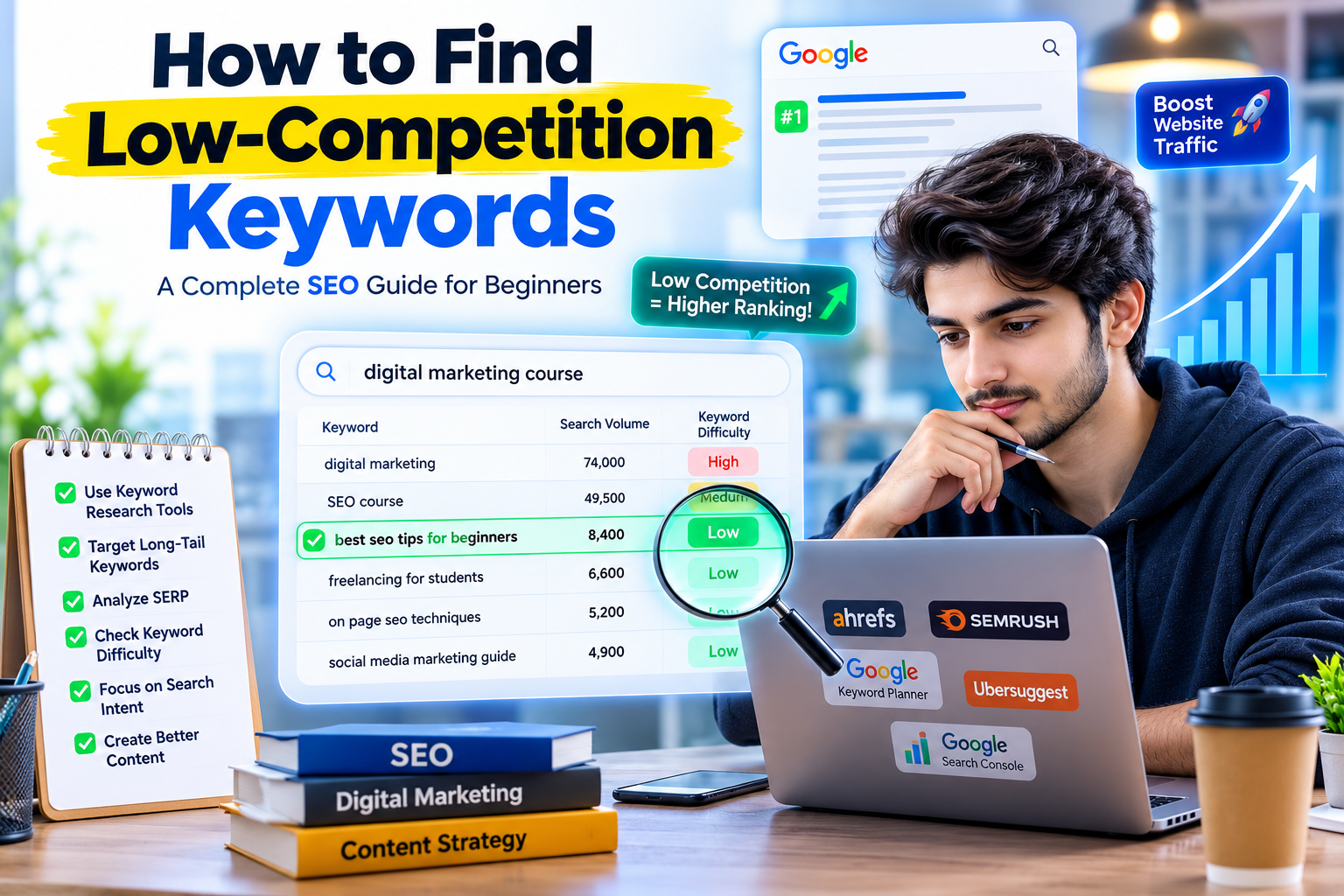
Finding the right keywords is one of the most important parts of a successful SEO strategy. Instead of targeting only highly competitive keywords, businesses and content creators can often achieve faster results by focusing on low-competition keywords with clear search intent.
Many websites struggle to rank because they target broad keywords that are dominated by established websites with strong authority and thousands of backlinks. A smarter approach is to discover low-competition keywords that have realistic ranking opportunities.
Low-competition keywords are search terms that are relatively easier to rank for because fewer authoritative pages are competing for the same query. They can be especially useful for new websites, small businesses, bloggers, local businesses, and niche websites.
Good SEO is not always about targeting the biggest keyword. It is about finding the right keyword for your audience and your website.
Low-competition keywords are search queries where a website has a reasonable opportunity to achieve visibility in search engine results. Competition can be influenced by the authority of competing websites, search intent, content quality, backlinks, topical relevance, and the specificity of the query.
For example, a broad keyword such as SEO is extremely competitive. A more specific keyword such as how to find low-competition keywords for a new website has a narrower intent and may provide a more realistic opportunity for a newer website.
Targeting lower-competition search terms can help you build organic traffic gradually while establishing topical authority. Instead of waiting months or years to compete for a highly competitive term, you can create useful content around specific queries and expand your keyword coverage over time.
Begin with a topic related to your website, product, service, or target audience. For example, if your website focuses on digital marketing, your main topic could be SEO, content marketing, local SEO, keyword research, or social media marketing.
Do not try to rank immediately for the broadest term. Use it as a starting point to discover more specific questions and long-tail keyword opportunities.
Long-tail keywords are longer and more specific search phrases. They usually describe a clearer problem, question, product, or intent.
| Broad Keyword | More Specific Keyword |
|---|---|
| SEO | SEO tips for small business websites |
| Keyword Research | how to find low-competition keywords |
| Local SEO | local SEO tips for small businesses |
| Content Marketing | content marketing ideas for beginners |
| Digital Marketing | digital marketing keywords for beginners |
Keyword research tools can help you discover related search terms, search volume estimates, keyword difficulty, trends, and competing pages. Popular SEO platforms can provide keyword suggestions that you can evaluate based on your website's authority and goals.
Do not select a keyword only because a tool gives it a low difficulty score. Always review the actual search results before deciding whether the keyword is a good opportunity.
One of the most useful ways to evaluate keyword competition is to search the keyword manually. Look at the websites ranking on the first page and evaluate whether their content genuinely satisfies the searcher's intent.
Check these factors:
Search intent is the reason behind a user's search. Understanding intent helps you create content that matches what users actually want.
| Search Intent | Example |
|---|---|
| Informational | how to find low-competition keywords |
| Commercial | best keyword research tools for SEO |
| Transactional | buy SEO keyword research tool |
| Navigational | Google Search Console login |
Questions are an excellent source of long-tail keyword ideas. Searchers frequently use phrases such as "how," "why," "what," "when," and "best" when looking for information.
Create content that answers these questions directly and thoroughly. Question-based keywords can also help you discover topics for blog posts, FAQ sections, guides, and supporting articles.
A keyword can be easy to rank for and still be a poor SEO target if it does not attract the right audience. Before creating content, ask whether the keyword is relevant to your products, services, audience, or business goals.
The best keyword is not necessarily the one with the highest search volume. It is the keyword that combines realistic competition with useful search intent and business relevance.
Keyword competition should be evaluated using several signals rather than a single metric. Keyword difficulty scores are helpful for comparison, but they are estimates and should not be treated as guarantees.
| Factor | What to Check |
|---|---|
| Search Intent | Does the keyword match the content you can provide? |
| Ranking Websites | How authoritative are the current top results? |
| Content Quality | Can you create something substantially more useful? |
| Backlinks | How strong is the backlink profile of competing pages? |
| Relevance | Is the keyword directly related to your niche? |
If you are starting keyword research, focus on specific queries instead of extremely broad topics. For example, an SEO website could explore topics such as:
These are examples of keyword patterns, not guaranteed low-competition terms. Always validate each keyword using current search results and your preferred SEO research tools.
High search volume does not automatically mean high-quality traffic. A keyword with lower volume can be more valuable if it attracts visitors who are genuinely interested in your topic or offer.
Different SEO tools calculate difficulty using different data and formulas. Use difficulty as one signal, then manually inspect the search results.
Even if a keyword looks easy to rank for, your page may struggle if it does not match the type of content users expect to see.
A low-competition keyword is not an excuse for low-quality content. Provide original, well-structured, useful information that fully addresses the user's question.
Keep the page focused on one primary topic and naturally include closely related terms. Avoid forcing keywords into headings or paragraphs simply to increase keyword frequency.
A practical strategy is to create a list of relevant topics, expand them into long-tail queries, evaluate competition, identify search intent, and prioritize the keywords that provide the best combination of relevance and ranking opportunity.
Finding low-competition keywords is about more than discovering a keyword with a low difficulty score. Successful keyword research combines relevance, search intent, competition analysis, content quality, and business value.
If you have a new or growing website, start with specific long-tail topics that your audience is actively searching for. Create genuinely useful content, connect related pages with internal links, monitor performance, and expand your strategy as your website gains authority.
The goal is simple: find realistic search opportunities, satisfy the user's intent, and create content that deserves to rank.
AI is no longer limited to researchers and engineers. It is becoming a valuable skill for everyone.
You already use AI every day. The next step is learning how it works and using it to create opportunities for your future.
The real question is: Will you simply use AI, or will you learn to build it?
Get started today by exploring AI and taking the first step toward a successful career.